About the Book
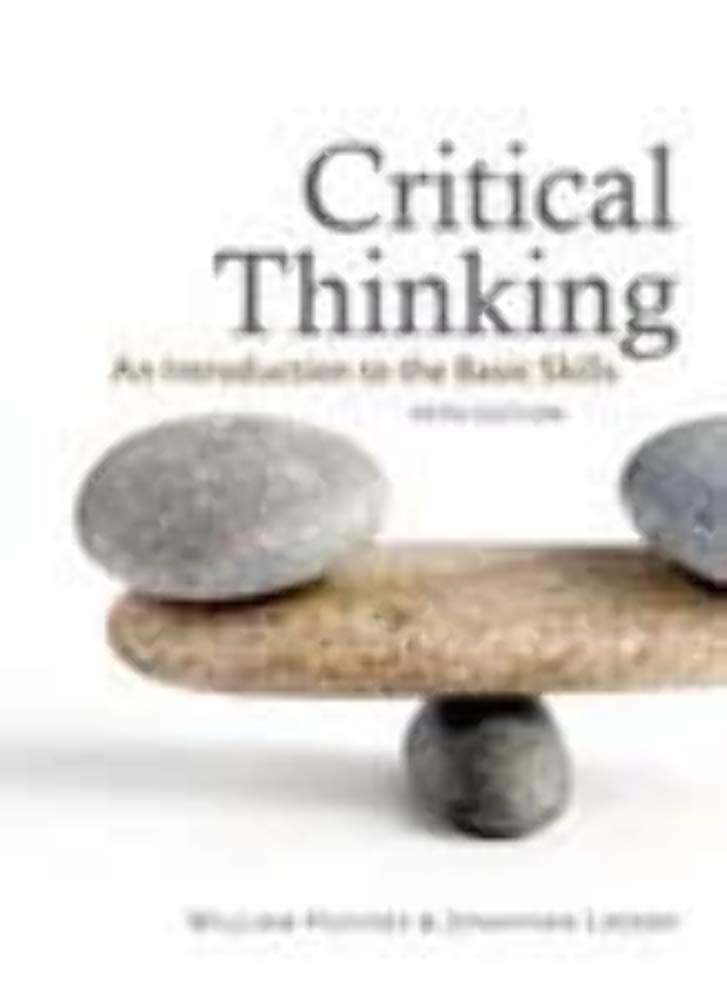
Critical Thinking: An Introduction to the Basic Skills is a comprehensive and accessible guide to developing strong reasoning, logical analysis, and independent thinking skills. Written by William Hughes, Jonathan Lavery, and Katheryn Doran, this book introduces readers to the fundamental principles of critical thinking and explains how to evaluate information, recognize weak arguments, and make better decisions.
The book explores how people construct arguments, interpret information, and reach conclusions. It teaches readers to distinguish facts from opinions, identify misleading statements, recognize logical fallacies, and assess whether evidence genuinely supports a particular claim.
Through practical examples, exercises, and thought-provoking questions, the authors demonstrate how critical thinking can be applied to everyday situations, academic studies, scientific discussions, moral questions, legal arguments, and media analysis.
Rather than simply telling readers what to think, the book encourages them to develop the ability to think independently, question assumptions, and reach conclusions based on sound reasoning.
It is particularly useful for university students, teachers, researchers, journalists, and anyone who wants to improve their intellectual abilities and become a more careful and informed decision-maker.
Detailed Summary
Understanding Critical Thinking
The book begins by explaining the meaning and importance of critical thinking. Critical thinking involves examining ideas carefully instead of accepting information without questioning it. It requires curiosity, logical reasoning, intellectual honesty, and the willingness to reconsider personal beliefs when presented with convincing evidence.
The authors explain that good thinking is not simply about having opinions but about being able to support those opinions with reliable reasons and appropriate evidence.
Meaning, Language, and Definitions
One of the central subjects of the book is the relationship between language and reasoning. Words can have different meanings depending on the context, and unclear definitions can create misunderstandings or weaken arguments.
Readers learn how to recognize ambiguity, clarify important concepts, distinguish descriptive meanings from evaluative meanings, and avoid misleading uses of language.
Understanding and Reconstructing Arguments
The book teaches readers how to identify the structure of an argument by distinguishing premises from conclusions.
It explains how arguments are constructed, how supporting reasons work together, and how to recognize assumptions that may not be explicitly stated.
This ability helps readers understand what someone is actually claiming and determine whether the conclusion follows logically from the available evidence.
Evaluating Arguments and Evidence
A major part of the book focuses on evaluating the quality of arguments. The authors introduce several important criteria:
These principles help readers avoid accepting conclusions simply because they sound convincing or are presented confidently.
Deductive and Inductive Reasoning
The authors explain two fundamental approaches to logical reasoning.
Deductive reasoning involves reaching a conclusion that necessarily follows from established premises, provided the argument is logically valid.
Inductive reasoning involves using observations, examples, and evidence to reach conclusions that are probable rather than absolutely certain.
Understanding the differences between these methods allows readers to assess scientific claims, everyday arguments, and predictions more effectively.
Recognizing Logical Fallacies
Another important subject is identifying errors in reasoning that can make arguments misleading or unreliable.
The book explores common logical fallacies, including false dilemmas, appeals to authority, irrelevant arguments, and other forms of faulty reasoning.
Readers learn how these techniques can be used intentionally or unintentionally to influence opinions and manipulate discussions.
Applying Critical Thinking to Real Life
The book extends critical thinking beyond theoretical logic and explores its practical applications in several areas:
-
Scientific reasoning: Evaluating hypotheses, research findings, and scientific evidence.
-
Moral reasoning: Examining ethical questions and evaluating moral arguments.
-
Legal reasoning: Understanding evidence, claims, and arguments in legal contexts.
-
Media analysis: Recognizing bias, misleading information, and persuasive techniques in the media.
-
Argumentative writing: Developing clear, logical, and well-supported essays.
Challenging Persuasion and Manipulation
The authors also examine irrational techniques of persuasion and explain how people can be influenced through emotional appeals, misleading statements, and poorly constructed arguments.
Readers learn how to respond effectively to weak arguments, question questionable claims, and defend their own positions using logical reasoning rather than emotional reactions.
Developing Better Thinking and Communication Skills
In its final sections, the book emphasizes the importance of organizing ideas, constructing persuasive arguments, and communicating clearly.
It provides guidance on writing argumentative essays, presenting evidence, anticipating objections, and building convincing conclusions.
Ultimately, critical thinking becomes a practical skill that can improve education, professional performance, communication, and everyday decision-making.
What You Will Learn
After reading this book, readers will be better able to:
-
Think independently and question unsupported assumptions.
-
Analyze arguments and identify their weaknesses.
-
Distinguish facts, opinions, and interpretations.
-
Recognize logical fallacies and misleading information.
-
Evaluate evidence and judge the reliability of claims.
-
Understand deductive and inductive reasoning.
-
Identify manipulation and irrational persuasion.
-
Make more informed and rational decisions.
-
Develop convincing arguments and communicate effectively.
-
Apply logical reasoning to everyday and academic situations.
READ THE BOOK ONLINE
Critical Thinking, Fifth Edition: An Introduction to the Basic Skills