About the Book
Technical reference · Antenna engineering · Radar and wireless communications
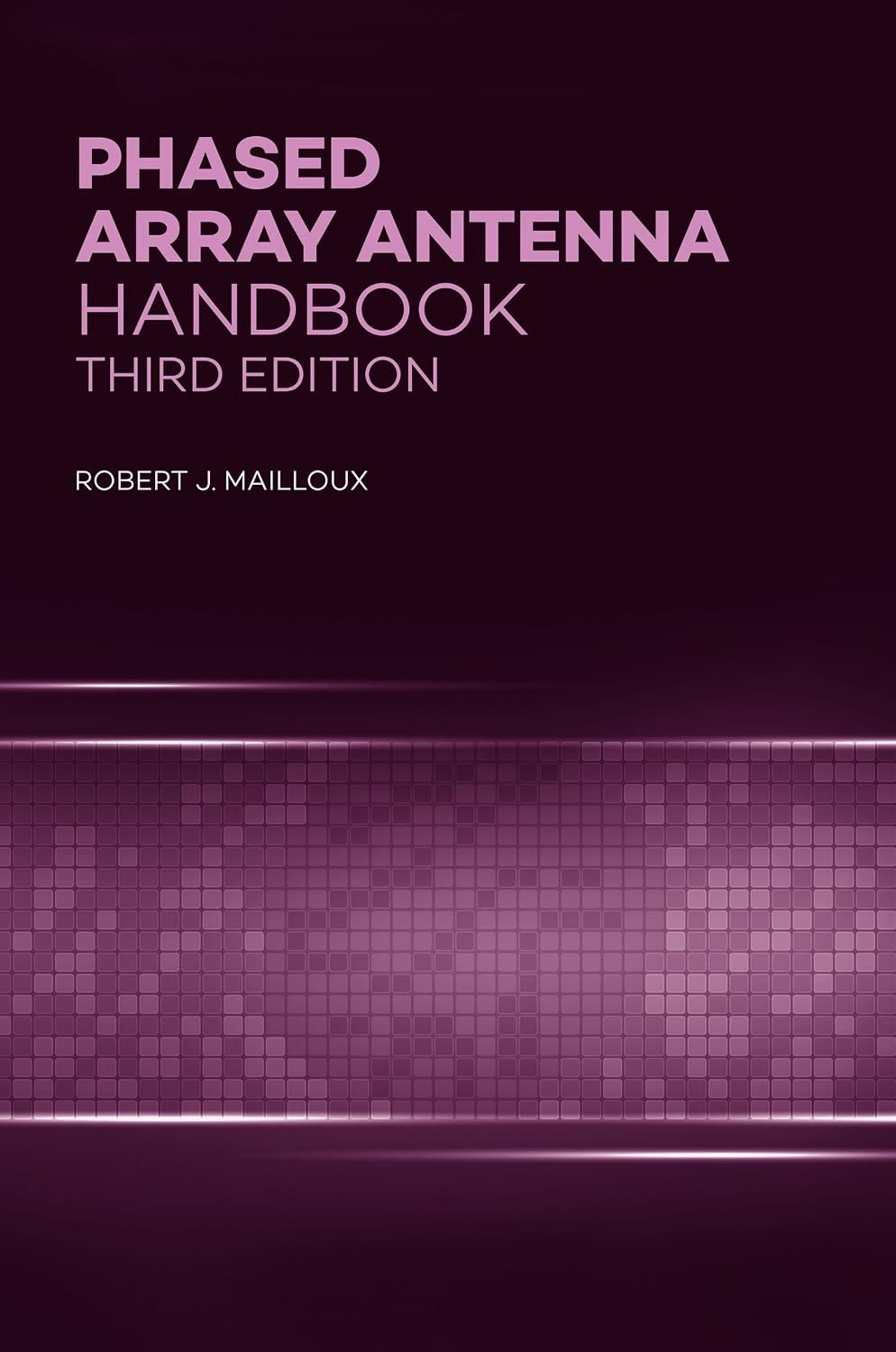
Phased Array Antenna Handbook, Third Edition is a comprehensive technical reference for understanding the principles, design, analysis, and practical applications of phased array antennas. This specialized engineering book explores how multiple radiating elements work together to control the direction and characteristics of electromagnetic radiation without requiring the entire antenna structure to move mechanically.
The book introduces the fundamental concepts of phased array technology and examines the relationship between antenna elements, phase control, beam steering, and radiation patterns. It is intended for antenna engineers, researchers, graduate students, and professionals working in radar systems, satellite communications, telecommunications, electronic warfare, and advanced wireless technologies.
Through its technical explanations and engineering-oriented approach, the handbook helps readers understand the challenges involved in designing antenna arrays that deliver accurate beam positioning, reliable performance, and efficient signal transmission and reception.
Detailed Summary
Phased Array Antenna Handbook, Third Edition focuses on the theory and practical engineering of phased array antenna systems. Its central theme is the coordinated operation of multiple antenna elements to produce and control directional electromagnetic beams.
Fundamentals of phased array antennas
The book explains how a phased array consists of multiple antenna elements arranged in a specific geometric configuration. By adjusting the relative phases of the signals supplied to these elements, engineers can direct the resulting radiation pattern toward a desired direction. This electronic beam steering is a key advantage over conventional mechanically steered antennas.
Beam steering and radiation patterns
An important topic is the relationship between phase distribution and beam direction. The handbook explores how engineers control the main radiation beam, manage sidelobes, and evaluate antenna performance. These principles are essential for developing systems that need to track moving targets, communicate with multiple users, or rapidly change their coverage direction.
Antenna array design and analysis
The book addresses the engineering considerations involved in arranging antenna elements and determining their spacing, geometry, and excitation characteristics. These design decisions influence gain, beamwidth, directivity, sidelobe levels, and the potential appearance of unwanted grating lobes.
Antenna elements and mutual coupling
Another major subject is the behavior of individual antenna elements and their interactions. The handbook examines different element types, including dipoles, monopoles, microstrip patches, and slot antennas. It also discusses mutual coupling, in which neighboring elements influence one another electrically, potentially affecting the overall array pattern and scanning performance.
Pattern synthesis and optimization
The author presents methods for shaping radiation patterns to meet specific engineering requirements. These techniques include conventional mathematical approaches and more modern optimization methods. They help designers achieve desired beamwidths, reduce sidelobes, and improve antenna performance under practical constraints.
Array errors and performance limitations
Real-world antenna systems are subject to amplitude and phase errors, component imperfections, and quantization effects. The book explains how these errors can change beam direction, reduce directivity, and increase sidelobe levels. Understanding these limitations is essential for designing reliable and accurate antenna systems.
Multiple-beam and wideband antenna systems
The handbook also examines antennas capable of generating multiple beams, as well as specialized array architectures designed for wide bandwidths or restricted fields of view. These subjects are particularly relevant to modern radar, satellite communications, and wireless systems that require flexible coverage and rapid electronic control.
Practical engineering applications
Throughout the book, mathematical equations, illustrations, and design-oriented explanations connect theoretical principles with practical antenna engineering. Readers learn how to evaluate gain, bandwidth, noise performance, and sidelobe levels, as well as how to make informed choices about array size, geometry, and feed architecture.
Google Books
Who Should Read This Book?
This handbook is particularly suitable for:
Electrical and electronic engineering students specializing in antennas and electromagnetics.
Antenna design engineers and RF engineers.
Radar and satellite communication specialists.
Researchers working on beamforming, wireless communications, and microwave systems.
Graduate students seeking an advanced reference on antenna array theory and design.
Readers should ideally have a background in electromagnetic theory, antennas, and basic engineering mathematics, as the material includes technical equations and specialized terminology.
READ THE BOOK ONLINE
Phased Array Antenna Handbook, Third Edition (Antennas and Electromagnetics) (English Edition)