Description:
About the Book
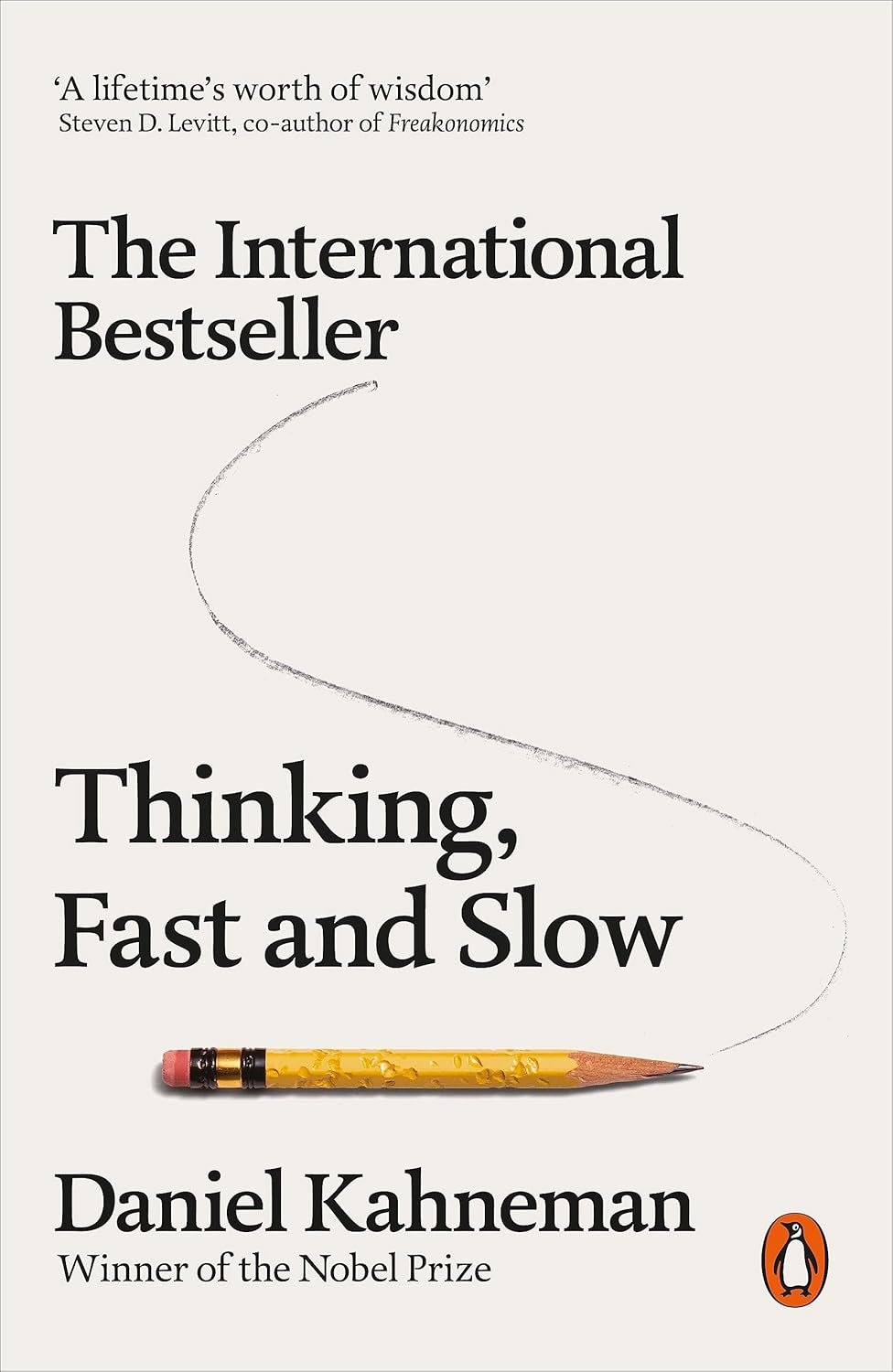
Thinking, Fast and Slow by Daniel Kahneman is a landmark book about human psychology, judgment, and decision-making. Drawing on decades of research in cognitive psychology and behavioral economics, Kahneman explains why people often make decisions that are influenced by intuition, emotions, mental shortcuts, and cognitive biases.
The book introduces two different modes of thinking. System 1 operates quickly, automatically, and intuitively, while System 2 is slower, deliberate, and analytical. Kahneman shows how these two systems interact and how their weaknesses can lead us to make predictable errors in everyday life, business, relationships, and important decisions.
Detailed Summary
Kahneman’s central idea is that the human mind does not always reason as rationally as we might believe. Much of our thinking happens automatically, without conscious effort. This is useful because it allows us to react quickly, but it can also cause systematic mistakes.
1. System 1: Fast Thinking
System 1 works automatically and requires little effort. It helps us recognize familiar faces, understand simple sentences, react to danger, and make intuitive judgments.
For example, when you see a simple mathematical problem such as 2 + 2, the answer appears immediately. You do not need to consciously calculate it.
However, System 1 can rely on shortcuts that sometimes produce inaccurate conclusions.
2. System 2: Slow Thinking
System 2 is responsible for conscious, effortful thinking. It is used when we solve complicated problems, analyze information, compare alternatives, or concentrate on something difficult.
System 2 is more deliberate, but it requires mental energy and attention. Because of this, people often rely on System 1 even when a situation would benefit from careful analysis.
3. Cognitive Biases
One of the book’s major themes is cognitive bias. Kahneman describes many ways our judgments can systematically deviate from logical reasoning.
Among them are:
-
Anchoring: relying too heavily on an initial number or piece of information.
-
Availability heuristic: judging how common something is based on how easily examples come to mind.
-
Confirmation tendencies: giving greater attention to information that supports what we already believe.
-
Overconfidence: being more certain about our judgments than the evidence warrants.
-
Loss aversion: feeling the pain of a loss more strongly than the pleasure of an equivalent gain.
-
Framing effects: making different decisions depending on how the same information is presented.
4. The Illusion of Certainty
Kahneman also examines why people are often overly confident about their predictions. We naturally create coherent stories from incomplete information and may fail to recognize how much uncertainty is involved.
This is particularly important when evaluating business decisions, financial investments, personal plans, and predictions about the future.
5. The Role of Probability
People frequently struggle to think statistically. We may focus on a memorable individual case instead of considering broader statistical evidence.
Kahneman explains concepts such as regression to the mean, base rates, and the law of small numbers, showing why limited evidence can easily lead us to misleading conclusions.
6. Losses and Gains
Another important concept is prospect theory, developed by Kahneman and Amos Tversky.
People don’t evaluate gains and losses symmetrically. In many situations, a potential loss feels more significant than an equivalent potential gain. This helps explain why people may avoid risks in some circumstances but take considerable risks when trying to avoid a loss.
7. The Experiencing Self and the Remembering Self
Near the end of the book, Kahneman distinguishes between the experiencing self, which lives through events moment by moment, and the remembering self, which evaluates those experiences afterward.
Our memories of an experience can therefore differ from what we actually experienced at the time. This has implications for how we think about happiness, vacations, pain, relationships, and life satisfaction.
READ THE BOOK ONLINE
Thinking, Fast and Slow
Retour